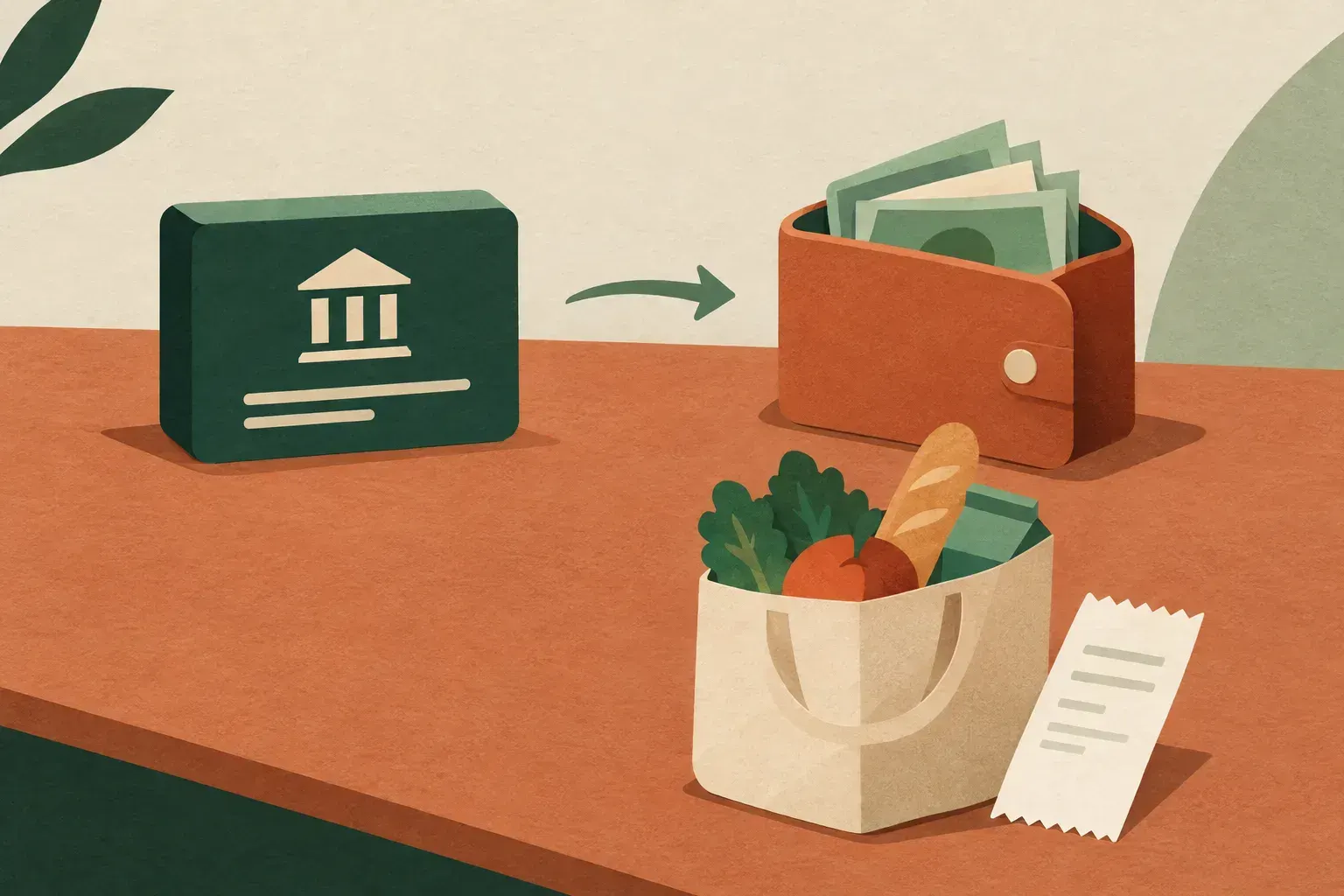
Withdrawing your own money from your bank account is not an expense if you continue tracking it as cash: it is a transfer between two accounts you own. Spending happens when you buy something with that cash or the bank charges a fee. Keeping these movements separate avoids counting both the withdrawal and the purchases as expenses.
In this article
What to record: withdrawal, fee and purchase
To track the full journey, include both your bank account and a cash account in your records. The money leaves the bank and enters your wallet; its location changes, but it is still yours.
Record the withdrawal as a transfer from the bank to cash. A fee is a separate expense in the account where it is charged; each subsequent purchase is an expense in the cash account, with the appropriate category.
This procedure covers debit withdrawals of your own money from your account. A credit cash withdrawal can create debt and additional costs: do not record it as though you had merely moved your own available money.
Fictional example: withdraw €100 and spend €50
Suppose you start with €1,000 in the bank and €20 in cash, with no other transactions or debts in this example. You withdraw €100 on a debit basis and the bank charges an additional €2 fee. You then pay €35 for food and €15 for transport in cash.
The bank balance ends at €898: 1,000 − 100 − 2. Cash ends at €70: 20 + 100 − 35 − 15. The combined balance is €968, compared with the initial €1,020.
Total spending is €52: 35 + 15 + 2. The €100 withdrawal is not added to that total. The €968 is the combined balance in this example, not a forecast of money left free after future bills or commitments.
Following the money: fictional example in euros
| Transaction | Bank | Cash | New spending |
|---|---|---|---|
| Opening balance | €1,000 | €20 | — |
| €100 debit withdrawal | −€100 | +€100 | €0 |
| Fee | −€2 | — | €2 |
| Food purchase | — | −€35 | €35 |
| Transport purchase | — | −€15 | €15 |
| Final result | €898 | €70 | €52 in total |
How to record this in Finantzak
In Finantzak for Android, you can represent your bank account and cash, record transfers and categorise expenses. Keep both accounts in your personal space and set opening balances for the same point in time, before the transactions you will add.
Record a €100 transfer from the bank to cash, a €2 expense in the bank account for the fee, and two cash expenses of €35 and €15. Use the actual dates and categories appropriate to your purchases; do not add new income for receiving your own banknotes.
Personal local use on Android is free; web access and personal synchronisation require Premium. Recording transactions does not withdraw money, pay for purchases or automatically connect to your bank: you are organising information that you need to check.
How to check that you have not counted money twice
Compare your recorded bank balance with transactions already posted by the bank, and count the notes and coins in your wallet. In the example, they should match €898 and €70 respectively, provided there are no other transactions.
If the bank shows a single €102 debit for the withdrawal and fee, your records should explain it with a €100 transfer and a €2 expense. Do not also record the €102 as another expense: that would duplicate the outflow.
If you previously recorded the withdrawal as an expense, review and correct that entry before adding a transfer representing the same transaction. If you are working with an imported statement, also check that you are not keeping both the original debit and its corrected representation.
A mismatch with your wallet does not, by itself, prove that a particular purchase took place. Review the opening balance, forgotten purchases, dates, fees and possible duplicates before changing amounts just to make them match.
What to check if the ATM charges a fee
In its article dated 10 August 2020, Banco de España explains that an ATM must disclose fees before completing a withdrawal and allow you to cancel. Check that notice and your bank's terms; this guide does not provide current fees for individual banks.
Keep or note enough detail to distinguish the cash received from the cost charged. Credit withdrawals and withdrawals abroad may have different conditions and are outside this example of a debit withdrawal in euros.
If you do not want to record every cash purchase
You can choose to stop detailed tracking when you withdraw cash, but the withdrawal then represents cash you no longer track individually, not an identified purchase. Do not also record subsequent purchases with that money as expenses without first reviewing that approach.
If you want to compare categories and check how much cash remains, tracking a cash account provides more information: record the transfer and then the purchases. The monthly spending guide explains how to combine this routine with the rest of your accounts.
Put it into practice
- Check that the opening bank and cash balances refer to the same point in time.
- Separate the amount withdrawn from any fee actually charged.
- Record purchases in the cash account without counting the withdrawal again as an expense.
- Check the bank balance and count the money in your wallet before finishing your review.