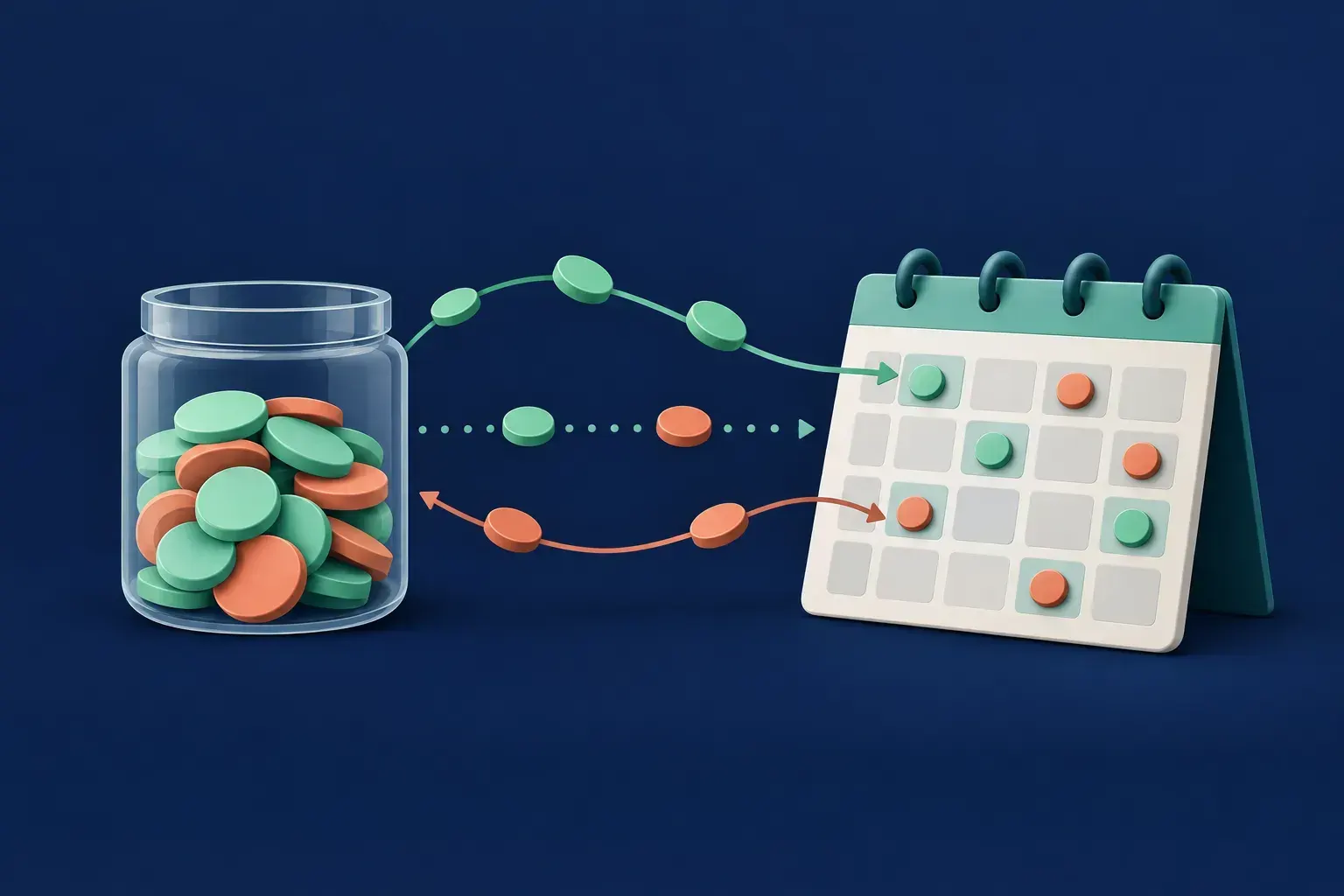
A positive balance tells part of the story: how much money is recorded now. On its own, it does not show whether that money will cover payments due before the next income arrives. Two schedules with identical amounts can end with the same balance yet pass through very different situations. That difference helps explain what a cash-flow projection offers—and what it cannot promise.
In this article
Monthly totals can hide a timing problem
A budget compares income and spending with the plan. A cash-flow projection adds their sequence: when income is expected and when payments fall due. Your Money, Your Goals, an educational toolkit from the Consumer Financial Protection Bureau (CFPB), explains that examining cash flow week by week helps identify mismatches that monthly totals can hide. It is a US educational framework, not a measurement of Spanish households or Finantzak users.
The recorded balance is not always money free to spend, either. There may be outstanding bills, amounts set aside or transactions not yet recorded. This does not make the balance useless: it answers a different question from how much room would remain under a particular schedule.
Two schedules, €1,400 at the end and different paths
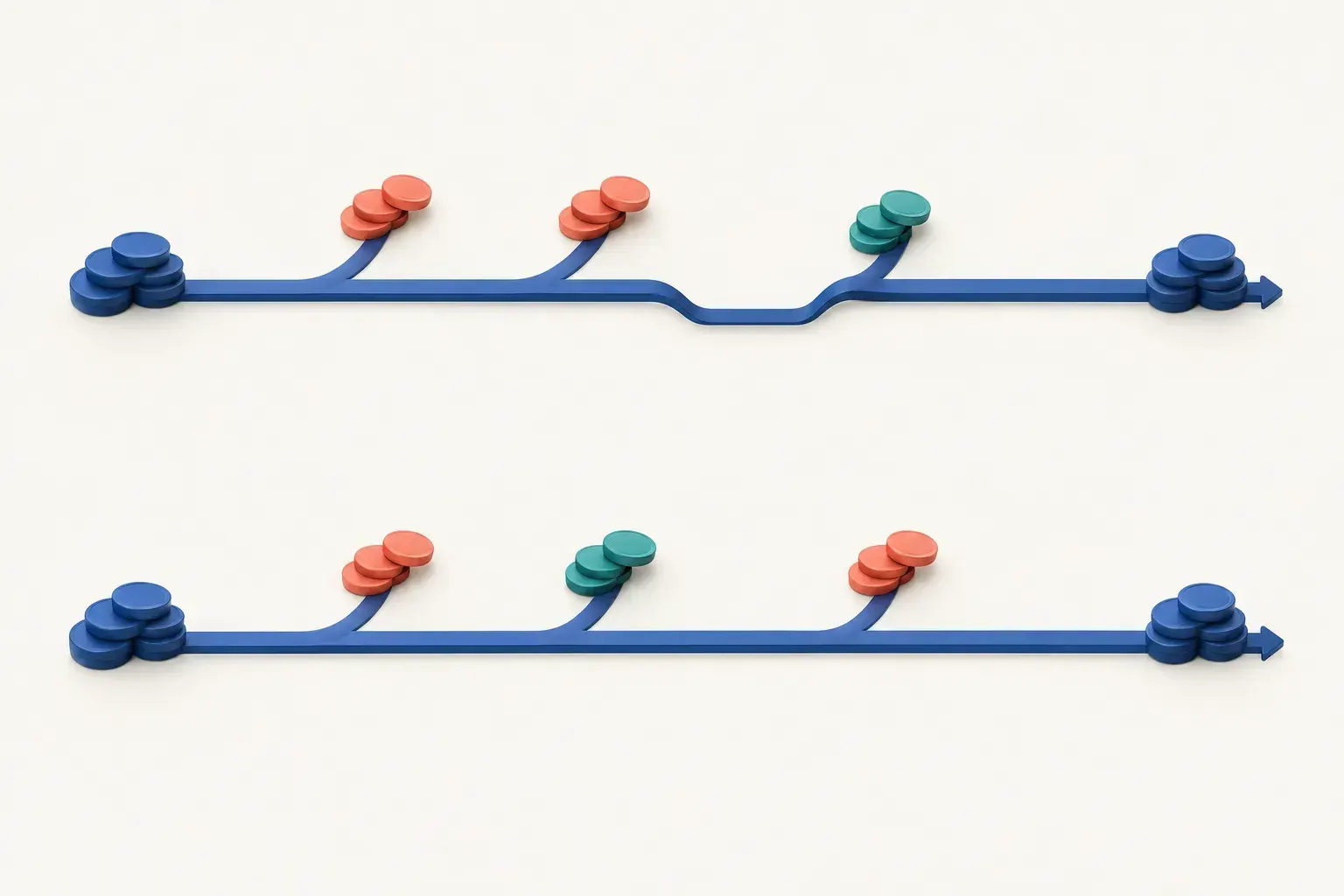
This example is entirely fictional. It starts with a €900 balance, two payments of €700 and €300, and income of €1,500. It includes no other spending, interest or fees. In schedule A, both payments precede the income; in schedule B, the income arrives between the payments. Only the sequence changes.
In A, the calculation moves from €900 to €200, then to −€100 and finally to €1,400. In B, it moves from €900 to €200, then to €1,700 and finally to €1,400. The common check is 900 − 700 − 300 + 1,500 = €1,400. Income minus spending is positive at €500; this is not the closing balance, which also includes the opening €900.
The −€100 in A indicates a shortfall within this projection, not an authorised overdraft or an observed bank balance. The positive final result does not remove that intermediate problem. Nor does B mean that €1,400 would be available for any purchase: the example leaves out all other commitments.
Fictional example: sequence changes intermediate cash flow
| Stage | Schedule A: transaction and balance | Schedule B: transaction and balance |
|---|---|---|
| Start | Balance: €900 | Balance: €900 |
| First event | €700 payment → €200 | €700 payment → €200 |
| Second event | €300 payment → −€100 | €1,500 income → €1,700 |
| Third event | €1,500 income → €1,400 | €300 payment → €1,400 |
What Toby adds to this distinction
According to Finantzak’s official product reference reviewed on 8 October 2026, Toby can combine recorded balances and planning to project cash flow and explore hypothetical scenarios. Its integration with authorised records makes it possible to ask about that schedule rather than relying on an isolated sum. Toby requires Premium, a connection, consent and service availability, and is subject to permissions and quotas; it is neither unlimited nor an assistant that works without Internet access.
The hypothetical question ‘With what I have and the scheduled payments, how would I reach the end of the month?’ requests an estimate, not a guarantee. Toby’s current conversational financial context is the authorised personal space; it should not be assumed to analyse every shared space or every external account.
Finantzak records and organises information: it is not a bank. A transfer between your own accounts adds neither income nor spending when both accounts are considered together, and must not be counted twice in totals. Recording a transfer or planning a bill in the app does not move real money or pay the bill.
A projection is only as useful as its stated assumptions
A useful reading of a projection considers the opening balance, dates, included payments and omitted spending. The example allows the result to be checked through every intermediate balance, not just the final figure. In a Toby projection, coverage depends on the available records: it does not know about unrecorded spending, and a separate estimate of variable spending requires sufficient history.
A payment date supplied for an income simulation does not automatically create an actual income entry. If sufficient history or a known next income is missing, that gap must be explained. ‘This amount would remain under these assumptions’ communicates a possibility; ‘you will have this amount’ promises something the projection does not establish.
The conclusion of this analysis is that timing does not necessarily change the monthly total, but it can change when money runs short. A projection adds value by showing that distinction and its limits, not by presenting the future as a confirmed balance.